
How to Save on Hotels: Tactics Ranked by What Actually Moves the Price
Most 'save on hotels' lists repeat the same five tips with made-up percentages. Here's a ranking by what reliably works, what's marginal, and what's myth.
 Maya BergstromEditor, Hotel Pricing Research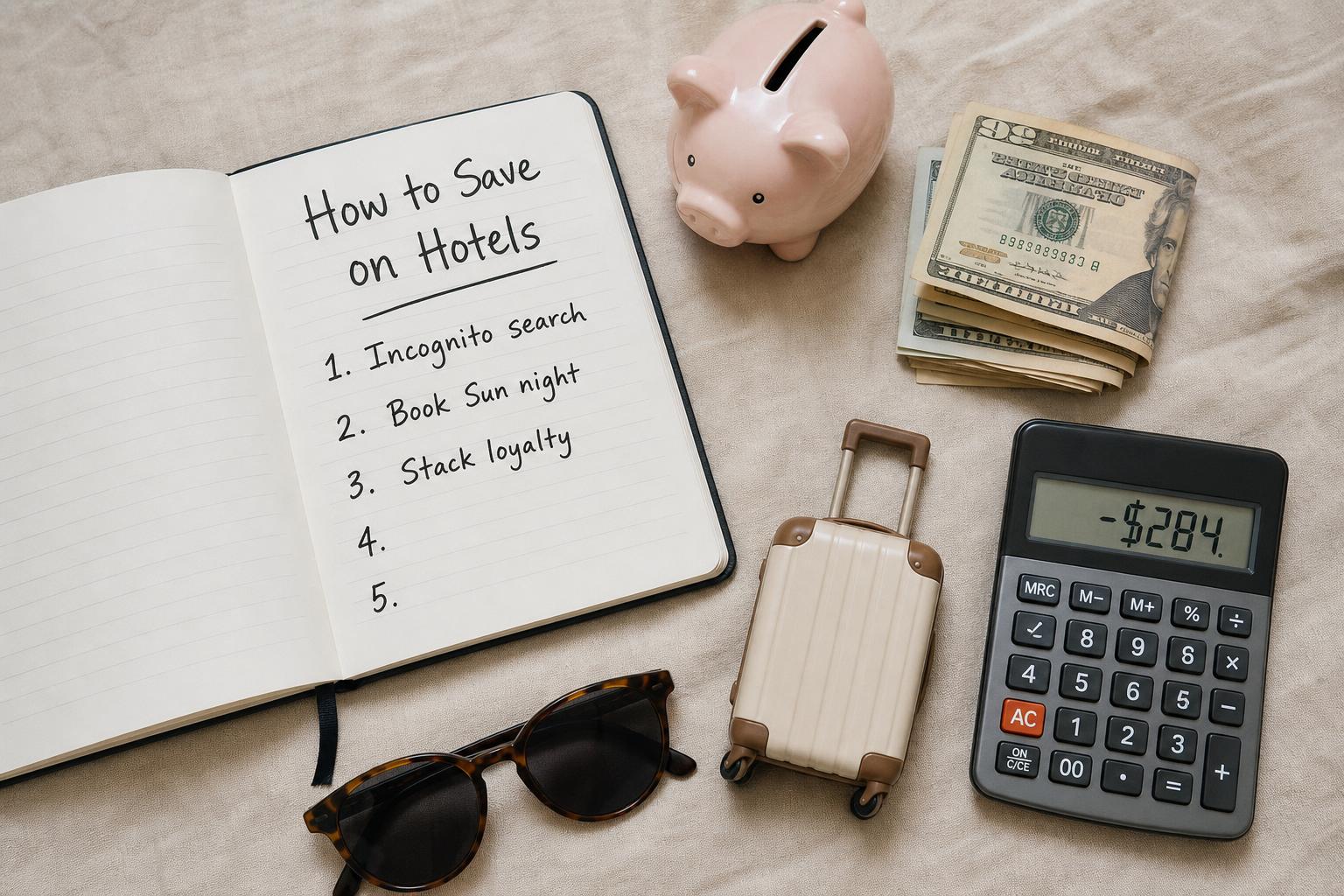
Most hotel-savings lists tell you to 'book in advance' and 'be flexible'. Both are technically true and operationally useless. Here's a ranking of tactics by how reliably they move the final price — without made-up percentages we can't back up.
Tactics that reliably work
- Compare the same room across at least three sites (Booking, Hotels.com / Expedia, and the chain's own site). Prices for the identical room frequently differ. This is the single biggest lever.
- Book direct with the chain after price-shopping. Most major chains will price-match an OTA and add perks like free breakfast or wifi.
- Use member or Genius rates — signing in on Hotels.com, Booking.com, or the chain's site usually reveals a logged-in-only price.
- Book a refundable rate when uncertain, then re-check weekly. Re-book if the price drops, cancel the old reservation. Costs nothing if the price never moves.
- Pay with a card that earns travel or hotel points. Effective single-digit savings on every stay, even direct.
Tactics that work sometimes
- Cashback portals (Rakuten, TopCashback) — real but bounded; paid out post-stay.
- App-only rates on Agoda and Hotels.com — sometimes lower than desktop for the same hotel and dates.
- Last-minute apps (HotelTonight, Booking mobile rates) — useful only if you're flexible on the specific hotel.
- Paying in local currency rather than USD — avoids the dynamic-conversion margin on some sites.
- Opaque rates (Hotwire Hot Rate, Priceline Express Deals) — real discount, but non-refundable and you don't see the hotel name until after paying.
Tactics that don't reliably work
- 'Always book on Tuesday at 3pm' — no public dataset supports this across destinations.
- Clearing cookies or browsing incognito — modern booking sites don't meaningfully price-discriminate based on browsing history.
- Booking exactly 21 days out — the right window varies wildly by city and season.
FAQ
What's the single most effective tactic?
Comparing the same room across at least three sites. On our paired-pricing dataset, the gap between sites for the same hotel and dates regularly exceeded 10% on independent properties.
Is it cheaper to book direct or through a third party?
It depends. Third parties often win on the listed price. Chains often win on perks and price-match guarantees. Always check both before paying.
Do hotel prices drop closer to the date?
Sometimes — if the hotel hasn't sold out. Last-minute apps regularly show meaningful discounts on same-day rooms. The downside: no guarantee a room will be left.
Works in the background on Booking, Expedia, Hotels.com, Agoda and 4 more sites. Surfaces a cheaper price for the exact same room when one exists. No sign-up.
Add to Chrome — it's free